


For anyone who has ever hidden behind a menu, pretended to be very interested in their phone, or speed-eaten a croissant while standing over a bin just to avoid the theatre of eating alone.
Let’s get the uncomfortable truth out of the way first: the first time you sit down alone at a restaurant in Europe — a proper sit-down, cloth-napkin, the-waiter-is-already-looking-at-you restaurant — you will feel, briefly, like a zoo exhibit. You will sense that every couple at every neighbouring table is secretly grateful they have someone to talk to. You will stare at the bread basket with slightly too much intensity. You will check your phone for notifications from people who have not texted you.
And then, if you stick with it, something shifts. The bread is warm. The wine is good. Nobody is actually looking at you. And you realise, slowly and then all at once, that eating alone might be one of the quiet, underrated pleasures of solo travel.
But getting to that realisation takes a little strategy, a little bravado, and — if you’re in France — the willingness to make eye contact with a maître d’ who has seen the full range of human timidity and is completely unimpressed by yours.
Here is the honest guide nobody handed you before you booked the trip.
The Mindset Shift You Actually Need to Make
European food culture, particularly in France, Italy, and Spain, is deeply communal. The table is a social institution. Sunday lunch in Bologna goes for three hours. Tapas in Seville are designed for sharing and shouting over. A long lunch in Lyon is essentially a group sport.
This can make the solo traveller feel like they are showing up to a wedding alone, sitting in the wrong pew, and ordering off a menu that wasn’t meant for them.
Here’s what nobody tells you: locals eat alone all the time. The difference is they don’t apologise for it. The Italian businessman at the marble counter of a Milanese bar, eating his risotto in twelve focused minutes before heading back to the office, is not embarrassed. The retired Frenchwoman at the corner table in Lyon, working through a carafe of Beaujolais and a pot-au-feu, is not performing loneliness. She is having lunch. These people have not agonised over their solo status. They are simply eating.
The mindset shift is this: stop treating eating alone as a problem to be managed and start treating it as a choice you are entitled to make. You are not half a couple who lost their other half. You are a person who is hungry, who is in Europe, and who has excellent taste in restaurants.
Once that clicks — and it does click, usually somewhere around day three — everything gets easier.
Sit at the Bar. Always Sit at the Bar.
This is the single best tactical advice for solo dining in Europe, and it applies from a Parisian brasserie to a pintxos bar in San Sebastián to an enoteca in Florence.
Bar seating removes the theatrical awkwardness of the solo table entirely. You are no longer conspicuously occupying a space designed for two or four. You are at the bar, which is where interesting, self-possessed people eat when they eat alone. You have the bartender or barista in front of you, which gives you a natural focal point that isn’t your phone. You can watch things happen — wine being poured, orders called back to the kitchen, the controlled chaos of service — and feel like a participant rather than an audience member.
In France, this is particularly easy. The zinc bar of a classic Parisian brasserie is practically a national monument. Pull up a stool at a place like any neighbourhood café on the Rue de Bretagne in the Marais and order a croque-monsieur and a glass of house white. Nobody will blink. The barman will chat to you if you seem open to it, or leave you alone if you seem like you want to read. It is the most civilised arrangement imaginable.
In Spain, bar culture is so embedded that sitting alone at the bar isn’t just acceptable — it’s efficient. At a tapas bar in Granada or a pintxos counter in the Basque Country, you order by pointing at what looks good, you eat standing up or perched on a stool, and you move on when you’re ready. There is no lingering awkwardness, no request for a table-for-one. You are simply part of the flow.
In Italy, the bar is where breakfast happens, always alone, always quickly. A cornetto and a macchiato at the counter costs half what it does at a table (this is literally true — sit-down service carries a cover charge), takes four minutes, and involves a brief, warm transaction with whoever is working the espresso machine. It is one of the great small pleasures of Italian daily life, and it is yours.
Counter Seating, Kitchen Views, and the Window Seat Strategy
When bar seating isn’t available, look for counter seating facing the kitchen or the street.
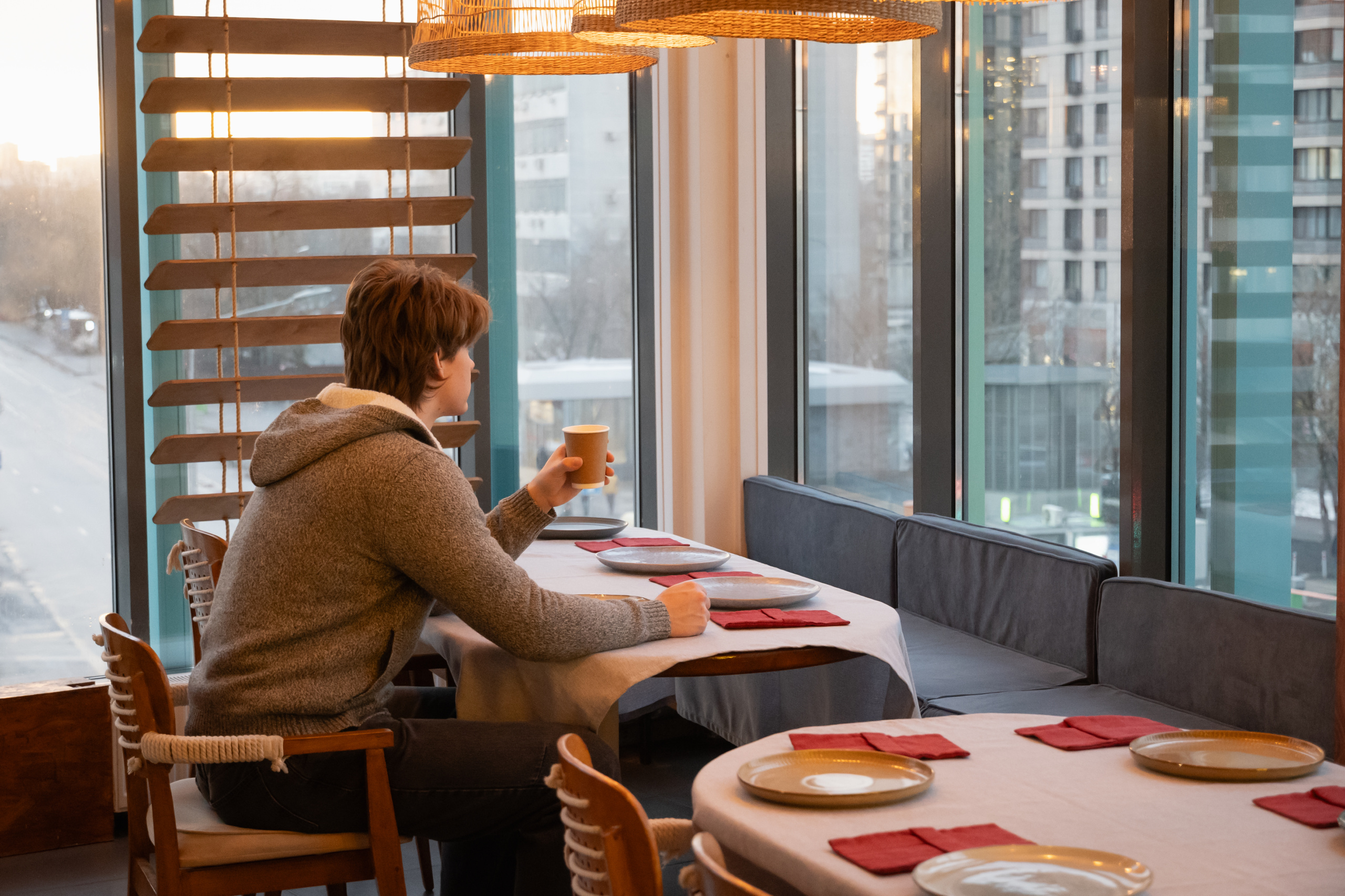
Many modern European restaurants — particularly the casual, no-reservation kind that solo travellers tend to favour anyway — have counter seats along a window or facing an open kitchen. These are, without question, the best seats in the house for a solo diner. You have something to watch. You are oriented outward, toward the world, rather than inward toward an empty chair. A window seat on a busy street in Rome or Barcelona is practically a floor show: you can spend forty-five minutes eating pasta and watching the street life outside with the same absorbed pleasure of someone watching a very good film.
Facing an open kitchen is even better. You can watch the cooks work, which is genuinely interesting, and the fact that your eyes have somewhere to go takes all the pressure off. Some of the best solo meals I’ve ever had were at counter seats watching someone make fresh pasta, plate small plates, or orchestrate the kind of controlled kitchen chaos that looks like disaster but produces perfect food.
When you’re making a reservation — yes, you should make reservations, even alone — ask specifically for counter seating or a seat at the bar. Most restaurants will accommodate this without comment. In France, you might say “Je préfère manger au comptoir si c’est possible” and the response will be entirely practical, not pitying.
Embrace Street Food and Market Lunches Like a Local
Here is a secret the guidebooks understate: some of the best food in Europe is eaten standing up, or sitting on a wall, or at a communal picnic table where nobody knows or cares who you came with.
The covered markets of Europe — the Boqueria in Barcelona (avoid the tourist traps at the front, go to the back stalls), the Marché des Enfants Rouges in Paris, the Mercato Centrale in Florence, the Mercado de San Miguel in Madrid — are paradise for solo diners. You navigate them at your own pace, you eat what catches your eye, and the whole experience is so pleasantly chaotic that sitting alone at a counter eating jamón ibérico or a slice of socca feels completely natural, because everyone around you is doing the same thing.
In France, assemble a picnic. This is not a consolation prize for people who couldn’t get a table — it is a French tradition. Buy a baguette from the nearest boulangerie (go early, before 9am if you can, when they come out of the oven). Add a wedge of something from a fromagerie, some charcuterie, a tomato, possibly a small bottle of something cold. Find a bench or a patch of park. The French have been eating this way for centuries and nobody has ever found it sad.
In Italy, street food is regionalized and spectacular. In Sicily, eat arancini from a bar window. In Naples, eat pizza fritta folded in paper and walking. In Rome, a supplì from a friggitoria will set you back about two euros and require no social performance whatsoever. These are not budget compromises. They are how the city actually eats.
In Spain, eat pintxos at lunch, standing at a bar in Bilbao or San Sebastián, making your way down the counter and picking up whatever looks interesting. This is an inherently solo-friendly activity. Nobody has ever felt awkward eating pintxos alone because the whole format is designed for exactly this kind of mobile, independent pleasure.
How to Handle the Maître d’ Situation
Ah. The moment. “Combien de personnes?” Two words in French that, in your first solo dining week, will make your stomach drop slightly.
“Just one” — or “uno,” or “une personne” — is a complete sentence. You do not need to explain, apologise, or add qualifiers. Not “just me, I’m afraid” or “only one, sorry” — both of which signal that you think being alone is an imposition. Simply: one person. Said with the mild confidence of someone who has made a reservation, arrived at the correct time, and expects to be seated.
Most maître d’s in Europe are entirely neutral about solo diners. The ones who give you the slightly pitying look — and a small number will — are not worth your emotional energy. You are paying customer. You are, in fact, slightly easier than a table of four.
The one thing that can happen, and you should be prepared for it: in very busy, very small restaurants, you may be asked to share a table. In France this is called “se mettre ensemble” and it is fairly common at bistros with communal seating. Say yes. These are often the most interesting meals you will have. The couple who sat down opposite me at a tiny Lyonnaise bouchon once spent the entire meal explaining the correct way to eat quenelles and argued gently with each other about it the whole time. It was wonderful.
The Phone: Friend, Crutch, and Occasional Prop
Let’s be honest: you will have your phone on the table. That is fine. Reading something genuinely interesting — an article, a book on your Kindle app, an actual book — is a completely dignified activity during a solo meal. The French have been reading at café tables since the invention of the café.
What to avoid: the compulsive, anxious scroll. Instagram, emails, the same three apps in rotation. It broadcasts “I don’t know what to do with myself” rather than “I am a person who enjoys their own company.” There is a difference, and it’s visible.
A notebook is even better. Writing while eating alone has a long, romantic precedent. You are practically channelling Hemingway in a Paris café, which is never a bad thing to be doing.
The Part Where It Actually Gets Good
Somewhere around the third or fourth solo meal — properly sat down, glass of wine, food in front of you — something unexpected happens. You notice things you wouldn’t notice if you were managing a conversation. The dynamic between the waitstaff. The older man at the next table who orders the same thing every Tuesday and is greeted by name. The way light comes through the window at 7pm in southern Spain and makes even a plate of patatas bravas look like a painting.
You eat more slowly. You taste things more carefully. You are, without meaning to be, fully present in a way that two people negotiating a shared experience often aren’t.
Eating alone in Europe is not a lesser version of travelling. It is, arguably, a purer one. The table is yours. The pace is yours. The bill, when it comes, is refreshingly small.
You do not need to perform enjoyment for anyone. You just have to show up, sit down, and order something good.
You’re going to be fine. Get the wine.
Got a solo dining experience of your own — good, awkward, or somewhere gloriously in between? Share it in the comments below.